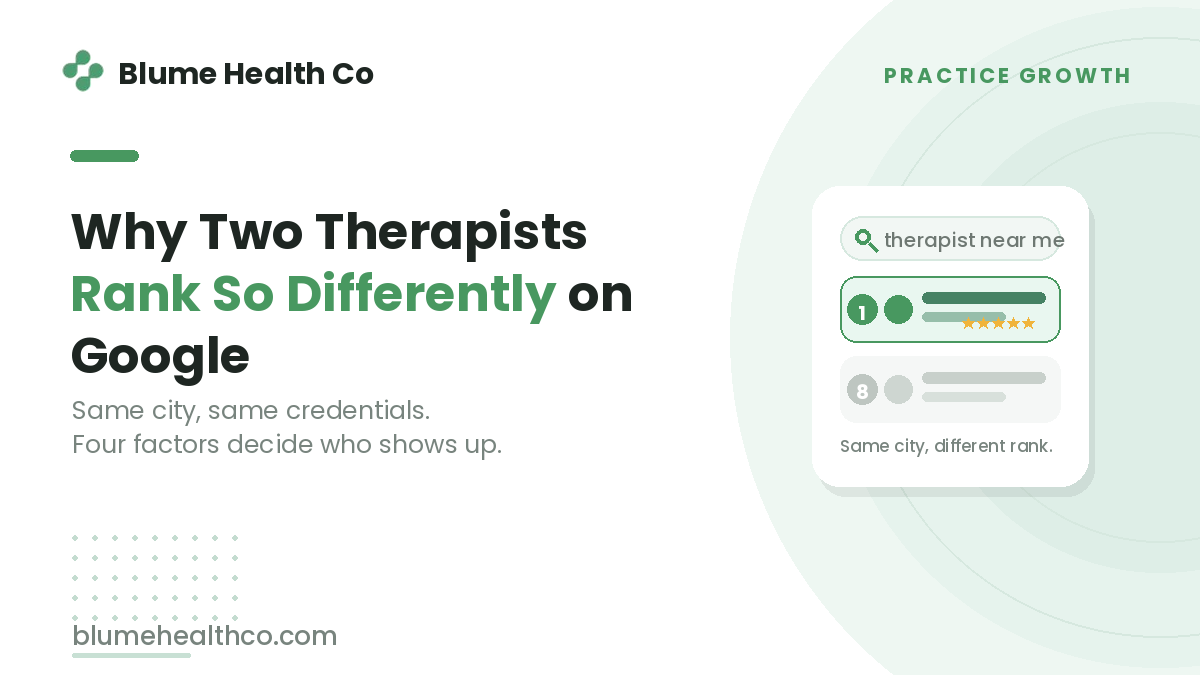
Why Two Therapists in the Same City Rank So Differently on Google
Two therapists in the same city. Similar credentials, similar fees. One shows up in the top three results when someone searches "therapist near me." The other sits on page three, invisible at the exact moment a potential client is deciding who to contact. Same qualifications, completely different visibility. So what's going on?
It's rarely about who's the better clinician. Google has no way of knowing that. It ranks on signals it can actually read, and most therapists have never been told what those signals are. Once you understand them, the gap stops feeling like bad luck and starts looking like a to-do list. Below are the four things that decide who ranks, in plain language, so you can see why your colleague outranks you and what to do about it.
Key takeaways:
- Google ranks local results on three things: relevance, distance, and prominence.
- Your Google Business Profile category is the single biggest lever you control.
- Reviews are the fastest way to close a ranking gap with a nearby competitor.
- Distance you can't change, but you can offset it with everything else.
- Inconsistent name, address, and phone details quietly sink you.
First, How Google Actually Ranks Local Results
When someone searches for a therapist near them, Google doesn't rank the results the way it ranks a blog post. Local results (the map with three listings at the top, often called the Local Pack or Map Pack) run on their own logic. That map shows up in roughly 93% of local searches, so it's usually the first thing a searching client sees.
Google has said publicly since 2016 that three things decide local ranking. Relevance is how well your profile matches what the person searched. Distance is how close you are to the searcher. Prominence is how established and trusted your practice looks across the web.
Almost everything below is one of those three wearing a different hat. When two therapists rank differently, the one who wins is simply stronger on the signals that feed those pillars. Building those signals on purpose is the whole point of SEO for therapists, and none of it requires being technical.
Reason 1: The Google Business Profile Category
Your Google Business Profile is the free listing that puts your practice on Google Search and Maps, with your hours, location, and reviews. Of everything on it, one field does the most work: your primary category.
The 2026 Local Search Ranking Factors survey, which is the industry's benchmark study of local SEO experts, named the primary Google Business Profile category the most influential local ranking factor there is. It's how Google decides what you are. And the specifics matter more than most therapists expect.
A profile whose primary category is a precise "Psychologist," "Marriage & Family Therapist," or "Mental Health Clinic" will beat one set to a vague "Health" or "Counselor" for the searches that actually matter. Picking the wrong primary category is one of the most common reasons a practice ranks poorly, and a mismatch can cut visibility by a large margin.
So if your colleague chose the specific, correct category and you left yours generic, that alone can explain the gap. The fix costs nothing but a few minutes.
Set the most specific primary category that describes your work, then add secondary categories for your other services. If you've never claimed or finished your profile, start there. Our guide to Google Business Profiles for therapists walks through every field.
Reason 2: Distance, the One Factor You Can't Change
Distance is the factor that frustrates therapists most, because there's nothing you can do about it. Google measures how far your verified address is from wherever the searcher happens to be, and a practice a mile away starts with an edge over one three miles out. In the 2026 survey, proximity was one of the two heaviest-weighted factors in the entire local algorithm.
This is often the quiet reason two similar practices rank differently. The person searching is simply closer to one office. When someone across town runs the same search, the results reshuffle in the other therapist's favor. Neither of you did anything wrong.
Here's the part that matters, though. Distance sets the starting line, but it doesn't decide the race. Google regularly ranks a slightly farther practice above a closer one when the farther practice has a more complete profile and more reviews.
You can't move your office to every client, but you can out-signal a closer competitor on everything else, which is what the rest of this list is about. One warning: never fake your address or list a location where you have no real presence to game distance. In 2026, that's a leading trigger for a profile suspension, which erases your visibility completely.
Reason 3: Reviews, the Fastest Way to Close the Gap
If distance is the factor you can't control, reviews are the one you can move fastest. They feed the prominence pillar directly, and their weight has climbed every year. The pattern in the data is hard to ignore. Practices with 50 or more reviews are far more likely to show up in the Local Pack than those with fewer than ten.
Reviews work on two levels at once. Google reads them as a trust signal, so volume, how recent they are, and whether you reply all move your position. Prospective clients read them as social proof, and a practice with a steady stream of recent, positive reviews simply looks more trustworthy than one with three reviews from two years ago. This is often the whole difference between two otherwise identical therapists. One asks every satisfied client for a review, the other never got around to it.
The catch for therapists is privacy. You can never confirm or reveal that a specific person is a client, including in a reply to a review. You can thank people warmly and speak in general terms, but a single careless reply can expose someone.
That's why a HIPAA-aware, automated approach helps: a system that asks for the review at the right moment, so your front desk doesn't have to remember. Our partners at Curogram cover the mechanics of this well, from how to get patient reviews the right way to broader patient engagement in behavioral health, and their reputation management tools automate the ask while keeping it compliant.
Steady beats sudden here. A slow, consistent trickle of genuine reviews signals a healthy, active practice far better than a one-time burst, and it lasts longer, because recency keeps counting in your favor.
Reason 4: NAP Consistency, the Silent Ranking Killer
NAP stands for Name, Address, and Phone number. It sounds trivial. It's also the reason more practices lose rankings than almost anything else. If your details don't match across your website, your Google profile, Psychology Today, and every other directory you're on, Google can't be sure you're one real, trustworthy practice, so it shows you less often.
The mismatches are usually small and accidental. "Suite 200" on your website but "Ste. 200" on Google. An old phone number on a directory you forgot you joined. Your name as "Dr. Jane Smith" in one place and "Jane Smith, LCSW" in another. Each tiny inconsistency chips away at Google's confidence, and the therapist whose details line up everywhere gets the benefit of the doubt you don't.
This is invisible work that pays off quietly. Auditing every place your practice is listed and making the name, address, and phone identical is one of the highest-return, least glamorous things you can do. It's the core of keeping your directory listings consistent across every platform. The more directories you're on, the more it matters, because each one is another chance for the details to drift.
Putting It Together
So why do two therapists in the same city rank so differently? It's almost always some mix of these four:
- The higher-ranked therapist picked a specific, accurate primary category. The other left it vague.
- The searcher happened to be closer to one office, which neither controls.
- One practice has a steady stream of recent reviews. The other has a handful, long gone stale.
- One has identical name, address, and phone details everywhere. The other has quiet mismatches.
The encouraging part is that three of the four are fully in your hands. You can't move closer to every client, but you can finish your profile, gather reviews more consistently, and clean up your listings. Stacked together, those routinely lift a practice above a closer competitor. The therapist who outranks you usually isn't luckier or better. They're just further down this list.
If your website itself never seems to surface no matter what you do, the problem may be structural rather than local. It's worth understanding why therapist websites never rank on Google, which is a different fix from the Map Pack signals above.
Where to Start
You don't have to do all of this at once. In rough order of impact for most private practices:
- Set your Google Business Profile primary category to the most specific option that fits, and complete every field.
- Put a simple, compliant system in place to ask satisfied clients for a review, consistently.
- Audit your name, address, and phone across every listing and make them identical.
- Fill out the rest of your profile, including photos, hours, and description, so it looks active and maintained.
Done together, this is what separates the therapist in the top three from the one on page three. If managing it across every platform feels like too much on top of a full caseload, that's the problem Blume Health Co was built to solve, with HIPAA-compliant local SEO and online presence management that keeps your practice visible so you can focus on care.
Frequently Asked Questions
Q. 1 Why does another therapist rank above me on Google?
Ans. Usually because they're stronger on one or more of the local ranking signals: a more specific Google Business Profile category, more recent reviews, more consistent listings, or simply being closer to the searcher. Google ranks on relevance, distance, and prominence, not on who's the better clinician.
Q. 2 What's the most important Google ranking factor for therapists?
Ans. For local search, your primary Google Business Profile category is the biggest factor you control. Setting it to the most specific option that describes your work, rather than a vague "Counselor" or "Health," is one of the highest-impact changes you can make.
Q. 3 How many Google reviews do therapists need to rank?
Ans. There's no fixed number, but the data shows practices with 50 or more reviews are far more likely to appear in the Local Pack than those with fewer than ten. What matters most is a steady stream of recent reviews, gathered in a HIPAA-compliant way, rather than a one-time burst.
Q. 4 Can I rank higher if I'm farther from the searcher?
Ans. Yes. Distance gives a closer practice an edge, but it doesn't decide the result on its own. A more complete profile, stronger reviews, and consistent listings regularly lift a slightly farther practice above a closer competitor.
Q. 5 What is NAP consistency and why does it matter?
Ans. NAP stands for Name, Address, and Phone number. When those details are identical across your website, Google profile, and every directory, Google trusts you as one real practice and shows you more often. Small mismatches, like an abbreviated street or an old phone number, quietly lower your rankings.