Marketing Channels for Mental Health Practices: Which Ones Are Actually Worth Your Time?
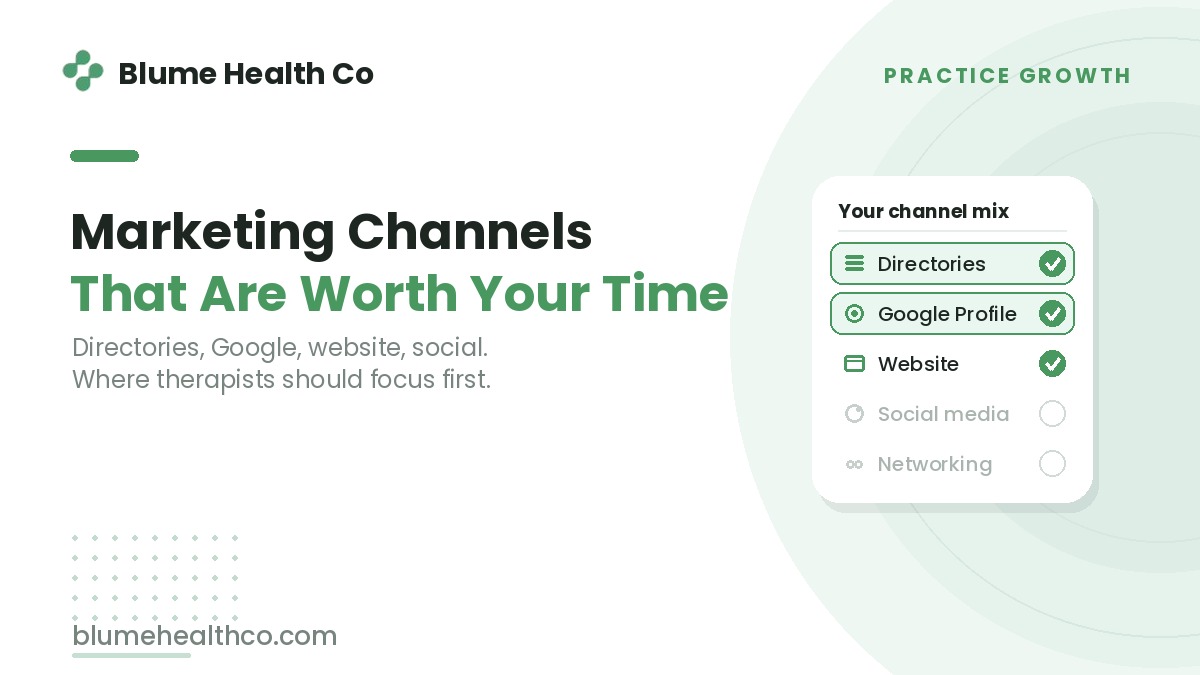
There is no single best marketing channel for a therapy practice. The real win is being present on a few platforms you can sustain, not stretched thin across every channel you have heard about. Pick the places your ideal clients already look, show up well there, and stay consistent.
This guide compares the real marketing channels for mental health practices: online directories, local search, your website, social media, and offline networking. You will see what each one is good for. You will also learn the difference between a channel and a platform, and how to choose based on your specialty and location.
Key Takeaways:
- A channel is a type of path to clients; a platform is a specific place within it.
- Aim to be present on a few strong platforms, not every channel at once.
- Your online reputation follows you across every channel, so reviews matter everywhere.
- What works depends on your ZIP code and specialty, test, keep what works, and stay consistent.
Marketing Channels vs. Platforms: What's the Difference?
A channel is the type of path clients take to find you; a platform is a specific place inside that channel. Online directories are a channel, and Psychology Today, Headway, and Alma are platforms within it.
This difference matters for how you spend your limited time. Many therapists try to be everywhere at once and burn out before they see results. The smarter move is to be present on multiple platforms, not spread thin across every channel you can name.
Think of it this way. You do not need directories, social media, networking, paid ads, and a podcast all running at once. You need two or three platforms you can keep current and respond to quickly.
The Main Marketing Channels for Therapists (and What Each Is Good For)
Most therapists get the best return from a small mix: online directories, local search, a simple website, and word-of-mouth. A strong online presence is now table stakes, because clients search online before they ever pick up the phone.
That shift is real. Mental health made up roughly two-thirds of U.S. telehealth claim lines in early 2024: 66.3% in January, rising to 67.2% in February, nationally (FAIR Health). That figure is the share of telehealth, not all therapy. Still, it shows how comfortable clients now are with finding and meeting providers online.
Here is a side-by-side look at the main channels.
| Channel | Best For | Effort | Cost | Who It Fits |
|---|---|---|---|---|
| Online directories | A steady flow of new-client inquiries | Low once set up | Free to about $30+/mo per listing | Almost every practice |
| Local search (Google Business Profile) | Being found by nearby clients | Low to medium | Free | Anyone with a local or in-person practice |
| Your own website | Building trust and credibility | Medium to build | Low ongoing | Practices wanting control and referrals |
| Social media & Facebook groups | Peer referrals and visibility | Medium, ongoing | Free | Therapists who enjoy posting and writing |
| Offline networking | Warm, high-quality referrals | Medium, ongoing | Low | Niche and youth-focused practices |
Online Directories
Online directories are usually the fastest path to a steady flow of inquiries. The goal is a solid platform stack: being listed and complete on the ones your clients actually use.
The main platforms to consider are Psychology Today, Headway, Alma, Rula, Healthgrades, and Zocdoc. Each has a slightly different fit. Psychology Today remains a leading general directory where people search for therapists. Headway, Alma, and Rula help with insurance credentialing and billing, which matters if you want more in-network clients. Healthgrades leans medical, and Zocdoc focuses on online booking.
Psychology Today is often the first stop for a solo practice. At its published rate of around $30 a month, a complete, well-written profile can carry a large share of your new-client flow. Fill in your specialties, your approach, and a warm photo, because those details are what turn a profile view into a call.
Zocdoc is a judgment call. It can bring in bookings, but it can also carry a meaningful per-booking cost. Watch what each new client actually costs you before you commit. Some practices find it pays off and others do not, which is exactly why you test it.
Local Search & Google Business Profile
Local search is how nearby clients find you on Google and Google Maps, and your Google Business Profile is free to claim. Fill it out completely, keep your hours and address current, and invite satisfied clients to leave a review where it is appropriate to ask.
Reviews now shape decisions everywhere. 41% of consumers say they always read reviews before choosing a local business, up from 29% a year earlier (BrightLocal). That figure covers general consumers choosing local businesses, not therapy clients specifically. Even so, the direction is clear: your reputation is part of every channel.
Reputation also protects the referrals you have already earned. 84% of healthcare consumers say they would reconsider a referral if the provider is rated below four stars (Press Ganey). Even a warm, word-of-mouth referral will look you up first, so a clean, complete profile guards the trust you have built.
One HIPAA note: keep review requests general, and never confirm or discuss anyone's care in public. Ask for feedback in a way that protects client privacy.
Your Own Website
Your website is the one platform you fully control, and it is where undecided clients go to feel confident before reaching out. A simple, clear site (who you help, how you work, and how to get in touch) is enough to do the job.
You do not need a large or fancy site. A homepage, an about page, a services page, and a contact page cover the basics and quietly support every other channel you use. Make sure any contact or intake form is HIPAA-compliant, so early messages stay private.
Social Media & Facebook Referral Groups
Social media builds visibility and trust over time, but one specific corner deserves your attention: local therapist Facebook groups. Many states and cities have private groups where clinicians refer clients to one another.
These groups are a real referral channel, not just chatter. When a colleague is full, out of network, or lacks your specialty, they post the referral. Clients then get matched to you. Join the groups for your state and city, be genuinely helpful, and make your niche clear so peers know when to send someone your way.
Public social media can wait if it drains you. Steady presence on one or two platforms beats scattered posting across all of them.
Offline Networking & Community
Offline networking still produces some of the warmest referrals, because it comes from people who know your work firsthand. Coffee with local physicians, other therapists, and community organizations builds a referral base that compounds over time.
If you serve youth or students, schools and colleges matter more than almost any online channel. School counselors, campus health centers, and student services refer out constantly. Being the therapist they already know puts you at the top of that list.
How to Choose the Right Marketing Channels for Your Practice
Start with two or three platforms you can realistically sustain, then add more only once those are running well. What works varies by ZIP code and specialty. Treat your first few months as a test: keep what brings clients and drop what does not.
Word-of-mouth still leads. In Heard's survey of private-practice therapists, word-of-mouth referrals ranked as the top way therapists find new clients, followed by Psychology Today, then other online directories (Fierce Healthcare). It is one survey, so treat it as a strong signal rather than settled fact.
The underlying pattern is consistent, though: relationships plus a complete online presence. A simple habit makes this easy. Ask every new client how they found you, and write it down. After a few months, the answers show you exactly where to invest.
If Psychology Today is part of your stack, keeping your Psychology Today profile optimized helps that inquiry flow stay steady. Pick your platforms, give each a fair test, and stay consistent - a few well-run platforms beat chasing every channel.
What's Changing: AI Search and Where Patients Look Next
AI search is an emerging way clients look for care, but it is not the main path yet. About one in five healthcare consumers say they have used AI to search for care (Press Ganey). That is enough to keep an eye on, not enough to build your whole plan around.
The good news is that the basics still cover you. Complete directory listings, an accurate Google Business Profile, and a clear website are exactly what AI tools pull from when they answer questions. Get those right, and you are already positioned for however clients choose to search next.
Conclusion
Marketing your practice does not mean being everywhere. It means choosing a few platforms your clients already use, then showing up consistently. That might be a directory or two, your Google Business Profile, a simple website, and the referrals that fit your niche. Test what works in your ZIP code and specialty, keep what brings clients, and let the rest go.
Keeping listings current across platforms can feel like one more job you do not have time for. That is where a partner like Blume Health can help, handling your online presence so you can focus on patient care. Start with the platforms above, give each a fair test, and build from there.
Ready to Grow Your Practice?
Put your online presence on autopilot and get found where clients search, without the busywork.
Frequently Asked Questions
Q. 1 What Is the Best Marketing Channel for a Therapy Practice?
Ans. There is no single best channel. For most therapists, a mix of online directories, local search, and word-of-mouth referrals works best. Choose the two or three platforms your ideal clients already use, and keep them consistent.
Q. 2 Is Psychology Today Still Worth It for Therapists?
Ans. For many solo practices, yes. Psychology Today remains a leading directory where clients search for therapists, and a complete, well-written profile can drive a steady flow of inquiries. Results vary by location and specialty, so track how many clients it actually brings you.
Q. 3 How Much Does It Cost to Market a Therapy Practice?
Ans. It can range from almost nothing to a few hundred dollars a month. A Google Business Profile is free. A major directory listing runs around $30 a month. Costs rise if you add booking platforms or paid ads, so start small and scale based on results.
Q. 4 Do I Need a Website if I'm on Psychology Today and Headway?
Ans. A website still helps, even with strong directory listings. It is the one platform you fully control, and undecided clients often visit it before reaching out. A simple site with your services and contact details is enough to build trust.
Q. 5 How Many Marketing Platforms Should a Solo Therapist Be On?
Ans. Two or three to start. Being present and consistent on a few platforms you can maintain beats being stretched thin across every channel. Add more only once your first platforms are running smoothly.