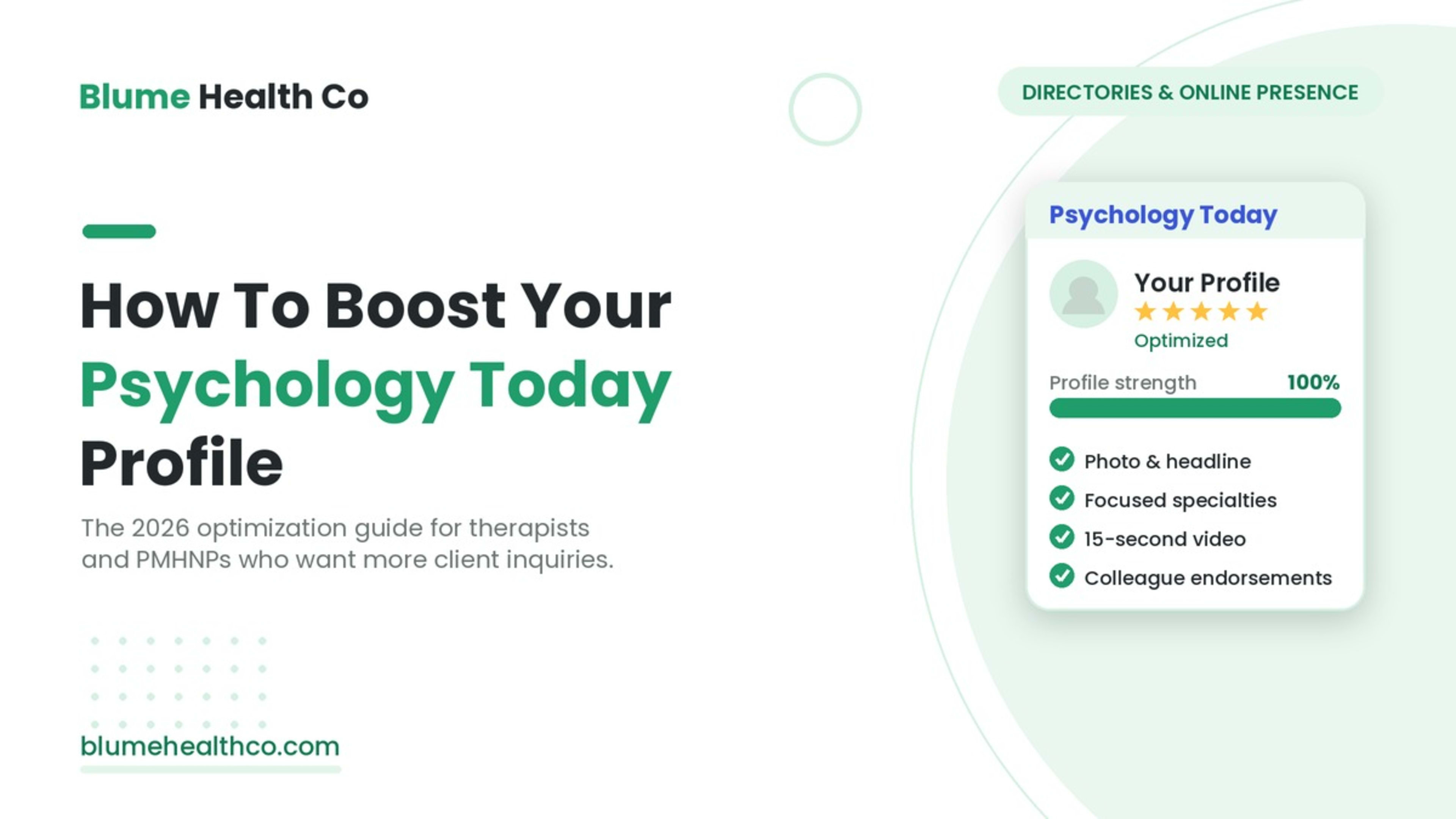
If you are wondering how to boost Psychology Today profile visibility (or how to boost your Psychology Today profile specifically), start here: your profile is likely written like a clinical resume, missing the signals the directory rewards, and prospective clients are skipping it. The fix is twofold, a structured rewrite that leads with the client's problem, and a set of optimization habits that tell the Psychology Today algorithm your profile is active, complete, and relevant.
Whether you are learning how to create a Psychology Today profile from scratch or fixing one that is not converting, this guide walks you through both. First, how the Psychology Today algorithm actually decides who shows up. Then, section by section, how to rewrite your profile, photo, headline, personal statement, specialties, video, and endorsements, and how to keep it ranking. Follow it step by step, and you will have a profile that holds attention past the 2 to 3 second scan window, surfaces more often in the directory, and converts more visitors into booked clients.
- Psychology Today referrals dropped 40 to 70% for independent therapists since 2020, but the platform still gets over 7 million visits per month. Your profile quality determines whether you capture that traffic.
- Psychology Today rotates profiles within a geographic area, but completeness, recent activity, colleague endorsements, and specialty relevance all influence how often you surface. Boosting your profile means feeding every one of those signals.
- Visitors spend 2 to 3 seconds scanning your profile before deciding to read further. Your photo and headline decide whether they stay.
- A rewritten, fully-optimized profile can double your click-to-contact rate (from 5% to 10%), twice the monthly inquiries from the same traffic.
- Because Psychology Today has high domain authority, an optimized profile often ranks on page one of Google for your name and location, sometimes faster than your own website. Treat it as an SEO asset, not just a listing.
- Your Psychology Today profile must work alongside your website, Google Business Profile, and directory listings. Clients use an average of 2.7 channels before booking.
How Does the Psychology Today Algorithm Work?
Before you rewrite a single word, understand what controls where your profile appears. Unlike Google, Psychology Today does not permanently rank one therapist at the top. It uses a rotation system: profiles rotate within a geographic area (a county, town, or zip code) so that different providers get exposure at different times. That is why your profile can sit on page one one week and page three the next without you changing anything.
But rotation is not the whole story, and this is where most therapists give up too early. Within that rotation, several factors influence how often and how prominently you surface:
- Completeness. Psychology Today rewards fully-filled profiles. Every blank field (specialties, insurance, video, gallery, finances) is a missed signal. More data means better matching, which the platform rewards with more visibility.
- Specialty relevance, the specialties and issues you select determine which filtered searches you appear in. A profile that matches five highly relevant searches outperforms one that loosely matches twenty.
- Recent activity, the algorithm appears to favor recently-edited profiles and active accounts. Profiles that are logged into regularly, that answer messages quickly, and that make small monthly edits signal that the provider is present and responsive.
- Colleague endorsements - Psychology Today lets colleagues write short recommendations for each other. These add to a visible endorsement count and place your name on other providers profiles, expanding reach and credibility.
- Location and listing areas, proximity is a heavy factor. Your profile automatically appears in your office area, and you can add additional listing areas to broaden where you surface.
Target Your Listing: Reach Up to Four Areas From One Profile
One of the most underused levers on Psychology Today lives in the Target Your Listing section of your dashboard. Your profile automatically appears in the area of your office location, and you can choose up to two additional listing areas where you want to market your practice, giving you presence in multiple cities or zip codes from a single profile.
For providers who work across a metro area, this is free reach. If you are in a densely-populated, saturated market, list surrounding, less-competitive areas you are genuinely willing to serve. A specialty search in a smaller adjacent town may have a fraction of the competing providers, which means you surface far more often there than in the crowded downtown core.
"You can appear in up to four areas from one profile: your auto-listed office location plus up to two additional listing areas, and (for teletherapy) throughout every state you're licensed in. Most providers use only one."
For PMHNPs and telehealth providers, the leverage is even greater. Because you can be licensed across state lines, your listing can show throughout an entire state's teletherapy directory - and you can strategically target the highest-intent areas within the states you are licensed in. The practical rule: cover the areas where your ideal patients actually are, confirm you are licensed to practice in every area you list, and review these annually.
The Login Hack: Why Active Profiles Rank Higher
Here is a signal almost no one talks about. Psychology Today's algorithm appears to reward profiles that show recent activity, and the platform's own systems favor recently-edited listings in default sort order. In plain terms: the directory wants to know your profile is live and that you are a responsive provider who will actually answer the clients it sends you.
The fastest way to improve Psychology Today profile visibility is to feed this signal deliberately. Log into your dashboard regularly (at least monthly, ideally more often) and make one small, genuine edit each time: refresh a sentence in your opening statement, adjust a specialty, update your availability, or swap a gallery photo.
- Log in and make one small edit at least once a month
- Answer new inquiries within 24 hours, speed wins the client and signals activity
- Keep your 'accepting new clients' availability status current
- Answer every blurb, prompt, and free-text field the editor offers, using client-language keywords
Why Your Psychology Today Profile Is Not Working Anymore
Psychology Today referrals are declining, and it is not just your practice. Independent therapists report 40 to 70% fewer referrals from the platform compared to two years ago. One group practice with 25 providers tracked only three successfully booked patients from Psychology Today over three full years, while paying $30 per provider each month.
The shift has a clear cause. Only 20 to 25% of therapy clients now use Psychology Today during their search, down from 30 to 35% in 2020. Google surfaces therapist information directly in local packs and knowledge panels, pulling clicks that used to go to the directory. But here is what makes the situation solvable: Psychology Today still gets over 7 million visits per month. The traffic exists. The problem is that most profiles read like clinical resumes, not client-facing copy, and most providers never touch the ranking signals above. That gap between what visitors want and what profiles deliver is the conversion killer. Close it, and the traffic you already have starts working harder.
The 2-3 Second Test: What Visitors See First
The algorithm determines whether your profile appears. What happens next depends on what visitors evaluate in about 2 to 3 seconds. If that scan does not connect, they scroll to the next listing. They spend 30 to 60 seconds reading only if the initial impression earns their attention.
Your photo is the first thing they see. Use a professional headshot with a warm expression and a neutral or office background. A photo that feels approachable and genuine keeps eyes on your profile. Skip the group-practice logo, people connect with people, not logos, and a real face in good natural light beats a poorly-lit studio shot every time.
Your headline comes next. State who you help and the outcome you deliver. 'Helping overwhelmed new parents find calm' is specific and client-facing. Your credential letters belong in the sidebar filters. Your first sentence determines whether visitors keep reading. Open with the feeling or situation your ideal client is experiencing right now. If your first sentence lists credentials or years of experience, you lose the reader before they reach your second paragraph.
How To Write Your Personal Statement
Knowing how to write a Psychology Today profile that converts comes down to this section: your personal statement does the most conversion work on your profile. Aim for 300 to 500 words. Profiles under 200 words feel incomplete. Profiles over 600 words lose scanners.
Structure it in four parts. Open with the client's pain point (2 to 3 sentences), using 'you' language. State your approach in plain terms (2 to 3 sentences), focusing on what happens in sessions rather than listing modality acronyms. Describe what working with you looks like (3 to 4 sentences). Close with a clear call to action (1 to 2 sentences) telling them exactly how to reach you.
Save clinical terminology for the approach section. Your opening paragraph should contain zero jargon. And write in the words your clients actually use, 'anxiety therapist' gets searched far more than 'CBT for generalized anxiety disorder.'
"Before: "I am a Licensed Professional Counselor with 12 years of experience specializing in CBT, DBT, and EMDR..." After: "You have tried managing your anxiety on your own, and it is not working anymore... I help adults who are stuck in that cycle find practical tools to quiet the noise." The second talks to the client. That difference determines whether someone clicks 'Contact' or scrolls to the next listing."
Choose Your Specialties Strategically: Don't Spread Too Thin
This is where most therapists quietly sabotage their ranking. Psychology Today lets you select from dozens of specialties, issues, and treatment approaches, and the instinct is to check every box that vaguely applies. The opposite works better. When you list twenty issues, you read as a generalist, and the algorithm sees a profile that loosely matches many searches instead of strongly matching a few.
Be intentional. Star the two or three specialties that are most central to your actual work and most aligned with the clients you want. If you are excellent at couples therapy, make couples work the unmistakable focus of your specialties, your headline, and your personal statement, rather than burying it among fifteen other issues. Consistency between your starred specialties and your written narrative signals to both the algorithm and prospective clients that you know exactly what you do.
"A profile that shows up in five highly relevant searches outperforms one that shows up in twenty loosely relevant ones. Pick a lane."
Add a 15-Second Video (Most Providers Skip This)
Psychology Today gives you the option to add a short intro video, and profiles that use it tend to get prioritized in search results and convert better, video lets prospective clients feel your warmth and approach before they ever reach out. Most providers skip it, which is exactly why it is an advantage.
It does not need to be cinematic. Psychology Today's own guidance is simple: face a light source and use a neutral background, film vertically on your phone (landscape videos are not accepted), smile, say a quick hello, and be yourself. You have up to about 15 seconds, say who you help and what it is like to work with you, in the same client-facing language as your written statement. A warm 15-second clip filmed on an iPhone in good natural light will do more for your profile than perfect production value ever could.
Get Endorsements From Colleagues (A Ranking Signal Hiding in Plain Sight)
Psychology Today lets you write short, 256-character recommendations for colleagues, and they can do the same for you. These endorsements appear on your profile, add to a visible endorsement count, and place your name on other providers' profiles when you endorse them. They do triple duty: they strengthen your credibility with prospective clients, they expand your professional network, and they feed the profile-strength and activity signals the platform rewards.
"Endorsements from colleagues boost credibility, expand referral networks, and feed Psychology Today's ranking signals. Exchange three to five with peers you respect."
The practical play: reach out to three to five colleagues you genuinely respect, write each a specific, warm endorsement, and ask them to do the same. Two thoughtful endorsements on your profile carry more weight than an empty section, and every endorsement you give plants your name on another well-trafficked profile.
Treat Your Profile as a Google SEO Asset, Not Just a Listing
Here is the shift that changes everything: your Psychology Today profile is not only a directory listing. It is one of the highest-authority pages on the internet with your name on it. Psychology Today has strong domain authority, which means Google trusts content on a PT profile more than the identical content on your own new website. In practice, a well-optimized profile often appears on page one of Google for searches like 'PMHNP in [your city]' or 'anxiety therapist in [your area]', sometimes faster and higher than your own site can.
That means your profile is doing double duty: it works inside the Psychology Today directory and it works as a Google search result. Write it accordingly. Include the location-based and symptom-based language clients actually type ('therapist in [city],' 'low confidence,' 'panic attacks') alongside your clinical terms. And link it to your website. Add your website URL to your profile, and add a 'Verified by Psychology Today' seal to your site so the two reinforce each other.
Credential-Specific Tips for PMHNPs, LCSWs, and LPCs
PMHNPs: Many clients do not know Psychiatric Mental Health Nurse Practitioners can prescribe medication. If you offer medication management combined with therapy, state that in your first two sentences. This differentiates you from talk-therapy-only providers in the same search results. Exchange endorsements with fellow PMHNPs, and if you practice across states, use your listing areas and teletherapy directory presence to cover every state you're licensed in.
LCSWs and LPCs: Prospective clients do not understand the difference between these credentials. Differentiate by population and presenting issue instead. Spell out your full credential title at least once ('Licensed Clinical Social Worker') before using the abbreviation.
HIPAA Considerations When Writing Your Profile
Your Psychology Today profile is public marketing material. Apply the same HIPAA lens you would to your website or a printed brochure. Never reference specific client cases, outcomes, or demographics in ways that could identify someone, even with details changed.
Psychology Today does not allow client testimonials on profiles. Beyond the platform rule, using client testimonials in healthcare marketing raises HIPAA concerns. Describe outcomes in general terms instead: 'Clients often report feeling less overwhelmed within the first month.' Avoid listing 'success rates' or treatment outcome statistics unless they come from published, peer-reviewed research. When in doubt, consult a HIPAA compliance advisor before publishing.
Make Your Profile Work With Your Other Channels
Your Psychology Today profile is one touchpoint in a multi-channel journey. Clients use an average of 2.7 different channels before booking their first session. Someone who finds you on Psychology Today will likely visit your website, check your Google Business Profile, or look you up on social media before reaching out.
That means consistency matters. Your Psychology Today profile, website bio, Google Business Profile, and directory listings (GoodTherapy, Zencare, TherapyDen, Healthgrades, WebMD, Apple Maps) should tell the same story. Cross-link your profiles. Your Psychology Today listing should link to your website, and your website should reference your PT profile. Track which channels drive inquiries by asking new clients 'How did you find me?' and recording the answer.
The Conversion Math: What a Better Profile Is Worth
Psychology Today costs $29.95 per month. If 100 people view your profile each month and your click-to-contact rate is 5%, you get 5 inquiries. Double that rate to 10% through the optimization steps in this guide, and you get 10 inquiries from the same 100 views. Your cost stays the same. Your results double.
Put dollar amounts to it: if your average client value is $150 per session across 10 sessions ($1,500 total), those extra inquiries (even if only 2 to 3 convert into ongoing clients) represent $3,000 to $4,500 in additional revenue. The profile rewrite takes 2 to 4 hours of focused work. Measure your progress by logging into your Psychology Today dashboard monthly: check profile views and contact clicks, then divide contacts by views and multiply by 100. That is your click-to-contact rate.
Conclusion
The providers who win on Psychology Today in 2026 do two things at once. They treat their profile as marketing copy (not a clinical resume) and they feed the signals the directory rewards: a complete profile, a focused set of specialties, a short video, colleague endorsements, targeted listing areas, and regular activity.
Of all the Psychology Today profile tips for therapists in this guide, start with the highest-impact changes: update your photo, rewrite your headline and opening to speak to your ideal client's problem, and star your two or three core specialties. Then add your video, exchange endorsements with colleagues, set your listing areas, and get into the habit of logging in monthly. Check your profile for HIPAA compliance, link it to a fast website, and align your other directory listings so every place a client finds you tells the same story.
Your Psychology Today profile rewrite starts today. Apply the framework section by section, and track your click-to-contact rate monthly. If you want expert help, Blume Health Co optimizes your Psychology Today profile as part of managing your full online presence across 40+ platforms, so every place a client finds you is working to book them. Explore our Psychology Today profile optimization service or book a free online-presence audit.
Frequently Asked Questions
Q. 1 How Do I Boost My Psychology Today Profile Ranking?
Ans. Psychology Today rotates profiles within a geographic area, so you cannot guarantee the top spot, but you can surface more often. Complete every field, star only your two or three core specialties, add a 15-second video, collect endorsements from colleagues, set your additional listing areas, and log in at least monthly to make a small edit. Answer inquiries within 24 hours.
Q. 2 How Does the Psychology Today Algorithm Work?
Ans. Psychology Today uses a rotation system that cycles therapist profiles within a geographic area so everyone gets exposure. Within that rotation, profile completeness, specialty relevance, recent activity, colleague endorsements, and proximity to the searcher all influence how prominently and how often you appear.
Q. 3 How Many Areas Can I Target on My Psychology Today Profile?
Ans. Your profile is automatically listed in the area of your office location, and you can add up to two additional listing areas in the 'Target Your Listing' section, up to three or four areas in total. Teletherapy providers can also appear throughout every state they are licensed in.
Q. 4 Does Logging Into Psychology Today Help My Ranking?
Ans. Yes. Psychology Today favors recently-edited, active profiles in its default sort order. Log in at least monthly and make one small, genuine edit, refresh your statement, adjust a specialty, or update availability. Answering client messages within 24 hours reinforces that you are an active, responsive provider worth surfacing.
Q. 5 Do Endorsements Help Your Psychology Today Profile?
Ans. Yes. Endorsements are short recommendations colleagues write for each other. They appear on your profile, add to a visible endorsement count, place your name on your colleagues' profiles, and strengthen credibility with prospective clients. Exchange three to five with peers you respect.
Q. 6 How Long Should My Psychology Today Profile Be?
Ans. Aim for 300 to 500 words in the personal statement. Profiles under 200 words feel incomplete to prospective clients, and profiles over 600 words lose scanners. Focus on four elements: the client's pain point, your approach in plain language, what sessions look like, and a direct call to action.
Q. 7 Should I Add a Video to My Psychology Today Profile?
Ans. Yes. Profiles with a short intro video tend to get prioritized in search and convert better. Film vertically on your phone with good natural light and a neutral background, smile, say a quick hello, and be yourself, up to about 15 seconds.
Q. 8 Can My Psychology Today Profile Rank on Google?
Ans. Often, yes. Psychology Today has high domain authority, so an optimized profile frequently appears on page one of Google for searches like 'therapist in [city]' or 'PMHNP in [area].' Include location-based and symptom-based language clients actually search, link your profile to your website, and treat it as an SEO asset.
Q. 9 How Do I Know if My Psychology Today Profile Is Working?
Ans. Log into your dashboard monthly and check two numbers: profile views and contact clicks. Divide contacts by views and multiply by 100 to get your click-to-contact rate. A rate below 5% signals your profile needs work.
Q. 10 Can I Use Client Testimonials on My Psychology Today Profile?
Ans. No. Psychology Today does not allow client testimonials on profiles, and using them in healthcare marketing raises HIPAA concerns. Describe the outcomes you help clients achieve in general terms instead.
Q. 11 Is Psychology Today Still Worth It in 2026?
Ans. Yes, with caveats. The directory still gets over 7 million visits per month, so the audience is there, but referrals have dropped 40 to 70% for independent therapists since 2020. The providers still getting results are the ones with fully optimized profiles and a presence across multiple channels.